By Garima Srivastava
Disclaimer: This article reflects my personal experiences, observations, and opinions. It is intended to encourage discussion about today’s hiring landscape and professional networking. It is not meant to target or defame LinkedIn, recruiters, employers, or any individual or organization.
LinkedIn Isn’t Broken—But It Has Changed
LinkedIn was once the go-to platform for professionals looking to build meaningful careers. It helped people discover opportunities, connect with recruiters, and expand their professional networks.
Today, the experience feels very different.
Many job seekers spend weeks applying for roles without hearing back. Others receive messages from fake recruiters or come across job postings that appear to have been inactive for months. Meanwhile, the news feed is increasingly filled with motivational stories and personal branding content instead of useful professional conversations.
This raises an important question:
Is LinkedIn still serving job seekers—or has it become something else?
The Rise of Ghost Jobs
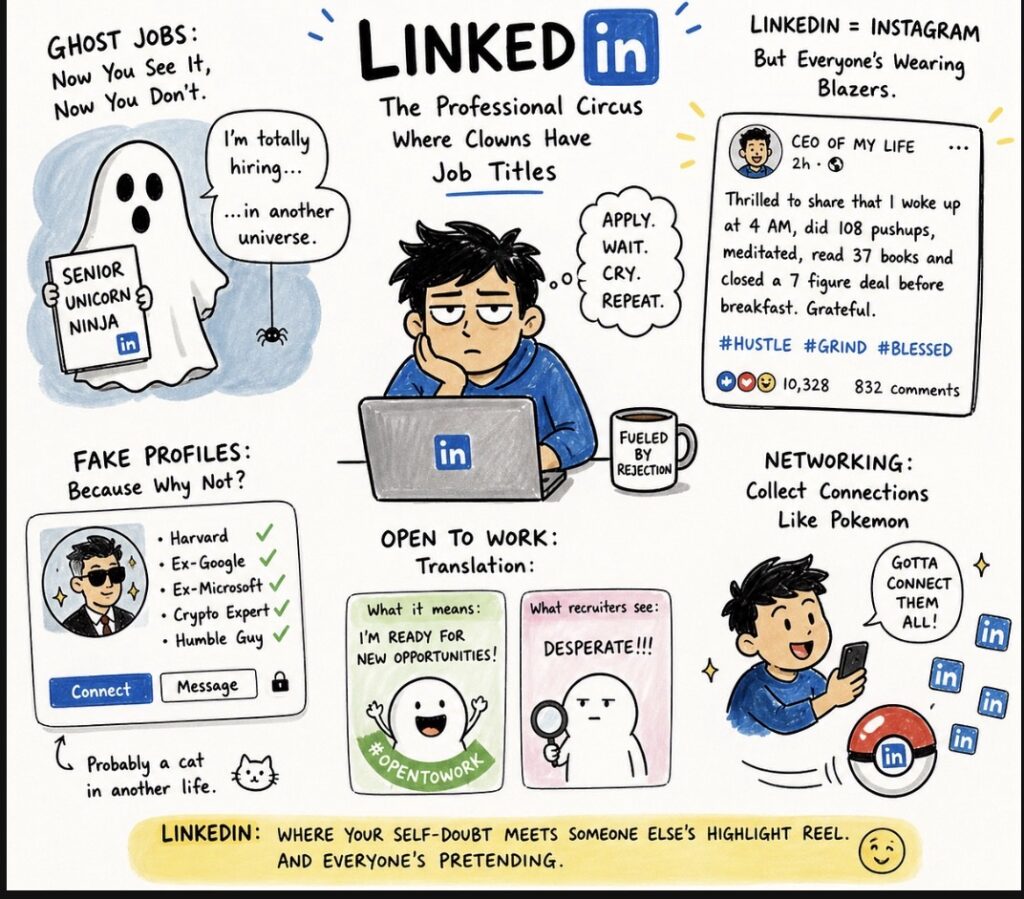
One of the biggest frustrations for job seekers is the growing number of “ghost jobs.”
These are positions that may already be filled, never intended to be filled immediately, or remain posted simply to collect resumes for future hiring.
For applicants, this creates a painful cycle:
- Hours spent tailoring resumes
- Emotional investment in each application
- Weeks of waiting
- No response
Research in recent years has suggested that many employers admit to posting jobs even when they are not actively hiring, making the application process increasingly discouraging for candidates. (Medium)
The result is simple:
Job seekers begin questioning themselves when, in many cases, there was never a genuine opportunity.
When Professional Networking Becomes Social Media
LinkedIn has gradually evolved from a professional networking site into a content platform.
Success on the platform often depends less on professional expertise and more on engagement.
Every day we see:
- Inspirational life stories
- Viral leadership lessons
- Emotional career posts
- Personal branding strategies
- Productivity hacks
Some of this content is valuable.
Much of it is designed primarily to maximize visibility.
The platform increasingly rewards content that generates reactions rather than content that helps professionals learn.
Fake Profiles and Recruiting Scams
Another growing concern is authenticity.
Although LinkedIn continues improving account verification, fake profiles remain a challenge across the platform.
Some are harmless spam accounts.
Others are created for:
- Resume harvesting
- Identity theft
- Investment scams
- Phishing attacks
- Fake recruiting campaigns
This is especially concerning because LinkedIn contains highly valuable professional information including employment history, education, certifications, and personal contact details.
Professional trust is exactly what makes these scams effective.
The “Open to Work” Dilemma
The green “Open to Work” banner was introduced to help job seekers become more visible.
However, many professionals worry that displaying it publicly may unintentionally create bias.
Whether those concerns are justified or not, the perception exists.
Fortunately, LinkedIn now allows users to share their job-search status privately with recruiters while hiding it from their public profile.
Personal Branding Is Becoming More Important Than Professional Experience
Today, visibility often determines opportunity.
Professionals who consistently publish content frequently receive more profile views than those quietly doing excellent work inside their organizations.
This doesn’t necessarily mean expertise has become less valuable.
It means visibility has become another skill.
For many professionals, maintaining a personal brand now feels like a second job.
What LinkedIn Still Does Well
Despite these challenges, LinkedIn remains useful when used intentionally.
It continues to be excellent for:
- Building professional relationships
- Researching companies before interviews
- Finding mutual connections
- Showcasing your experience
- Being discovered by recruiters
- Following industry leaders
The platform still creates opportunities.
It simply requires more realistic expectations than it once did.
My Advice to Job Seekers
If you’re actively searching for your next role:
- Don’t judge your worth by application responses.
- Verify recruiters before sharing personal information.
- Focus on networking, not just applying.
- Keep your profile updated.
- Build genuine relationships instead of chasing algorithms.
- Diversify your job search beyond a single platform.
Most importantly, remember that silence from a job application is rarely a reflection of your abilities.
Final Thoughts
LinkedIn isn’t entirely good or entirely bad.
It is a powerful platform operating within incentives that prioritize engagement, growth, and business objectives.
Understanding those incentives allows professionals to use LinkedIn more effectively instead of becoming discouraged by it.
Use LinkedIn as a tool—not as a measure of your professional value.
Your career is far bigger than any algorithm.